Frozen in the Ice: Exploring the Arctic

Frozen in the Ice: Exploring the Arctic

Image
MOSAiC Image

Module 1 - Course Introduction and Course Basics

MOSAiC Image

About this Course

Why would hundreds of scientists from around the world intentionally freeze a ship in Arctic sea ice for an entire year, braving subzero temperatures and months of polar darkness? This may sound like a fictional adventure movie plot, but from September 2019 through October 2020, the MOSAiC (Multidisciplinary drifting Observatory for the Study of Arctic Climate) Arctic research expedition did just this. 

In this course, you’ll hear directly from MOSAiC scientists and Arctic experts as they describe why this expedition is so key for increasing our understanding of the Arctic and global climate systems and what kinds of data they will be collecting during MOSAiC on the ice, under the sea, and in the air. The course kicks off with content around Arctic geography, climate, and exploration history, and then walks learners through the basics of the components of the Arctic system: atmosphere, ocean, sea ice and ecosystems. You will also learn how the data collected during MOSAiC will be used to improve climate model projections. Finally, we will wrap up the course by exploring challenges the new Arctic faces, including how indigenous peoples in the Arctic are being impacted in different ways by a changing Arctic environment.

What you will learn

  • Through virtual participation in one of the most extensive Arctic expeditions, learners will understand the critical components of the Arctic climate system – atmosphere, ocean, sea ice and ecosystems – and how they are interconnected.
  • Learners will be able to outline what climate science is, what kind of data climate scientists collect in the Arctic, and how research findings from these data inform our understanding of weather and climate.
  • Through the lens of the MOSAiC expedition, learners will discuss the critical challenges the Arctic environment and Arctic communities face under a changing climate and how these changes impact people globally.

Photo of Anne Gold

Anne Gold

Anne U. Gold, PhD, is one of the primary instructors for the MOSAiC Frozen in the Ice course. She is the former Director of the CIRES Center for Education, Engagement and Evaluation, and a Fellow and Senior Associate Scientist at the Cooperative Institute for Research in Environmental Sciences (CIRES) at the University of Colorado in Boulder, and an Affiliate Faculty member of CU's School of Education. She focuses on science education for educators, students, communities and the public around climate, water, environmental hazards, polar regions and geosciences in general. She is interested in understanding and studying effective ways of teaching and learning and is dedicated to grounding her education work in rigorous research and evaluation. She is passionate about building local partnerships with communities. Anne has led dozens of NSF, NOAA and NASA-funded education projects. As the founding director of CEEE, she formed a vibrant group of outreach and education professionals who develop engaging and meaningful educational opportunities for all learners. She is a climate scientist by training with a doctoral degree from the University of Regensburg in Germany. 

Photo of Matthew Shupe

Dr. Matthew Shupe

Dr. Matthew Shupe is the other primary instructor for the MOSAiC Frozen in the Ice course. He is a research scientists with the Cooperative Institute for Research in Environmental Sciences at the University of Colorado and NOAA Earth System Research Laboratories. Since the late 1990s his research has focused largely on Arctic cloud and atmospheric processes and their interactions with the surface, primarily using ground- and aircraft-based observations. Field work has been a major element of this research, including work at numerous Arctic field stations, atop the Greenland Ice Sheet, in mountain environments, and aboard icebreakers in the Arctic sea ice. Matthew is a member of the PSL Cryosphere Processes research team, a member of the DOE Biological and Environmental Research Advisory Committee, and a Mercator Fellow associated with a large German transregional program focused on Arctic Amplification. He is co-coordinator of the Multidisciplinary drifting Observatory for the Study of Arctic Climate (MOSAiC) expedition, a yearlong international observational and modeling initiative in the central Arctic ice pack that targetted the coupled processes linking the changing Arctic atmosphere, sea ice, ocean, and ecosystem. For more information check out "Five Questions for Matthew Shupe."

Course Format and Schedule

Course Format:

The class consists of short (between 6 and 15 minutes in length) lecture videos featuring experts in specific topics, many of which are part of the MOSAiC expedition. Each module ends with an assignment, includes suggested readings to connect more with the MOSAiC expedition and discussion prompts , while a final assessment will enable you to apply what you have learned.

Assignments and Grading Policy:
  • Module Assignment Atmosphere (15%)
  • Module Assignment Arctic Ocean (15%)
  • Module Assignment Sea Ice (15%)
  • Module Assignment Ecosystem/Biogeochemistry (15%)
  • Module Assignment Modeling (15%)
  • Final Assessment - Peer Reviewed (25%)
Suggested Readings:

There are no required readings for this course but we will provide links to optional reading materials in each module to provide more connections with the expedition. Completing readings or exploring additional resources is NOT part of the course requirement.

Recommended Background:

There are no prerequisites for this course, and no prior knowledge is assumed.

Course Schedule:

Note: Because this course is highly interdisciplinary and taught by over 35 experts who deliver lectures on their areas of expertise. 

Module 1: Introduction 
  • Video 1: Module Overview (Anne Gold, CIRES, University of Colorado ; Matthew Shupe, CIRES, University of Colorado, NOAA)
  • Video 2: What and Where is the Arctic? (Mark Serreze, CIRES, University of Colorado, CIRES, National Snow and Ice Data Center)
  • Video 3: Geopolitics of the Arctic - Great Powers, Strong Institutions, Scientific Cooperation (Sandy Starkweather, CIRES, University of Colorado, NOAA)
  • Video 4: The MOSAiC expedition - an Overview (Matthew Shupe CIRES, University of Colorado, NOAA)
  • Video 6: Exploring the New and Old Arctic - MOSAiC and the Historic Fram Expedition (Jon Griffith, CIRES, University of Colorado)
Module 2: Atmosphere in the Arctic and beyond
  • Video 1: Module Overview (Anne Gold, CIRES, University of Colorado ; Matthew Shupe, CIRES, University of Colorado, NOAA)
  • Video 2: Role of the Arctic in Earth’s Energy Budget (John Cassano, CIRES, University of Colorado)
  • Video 3:Up in the Air: Earth's Atmosphere (Chris Cox, NOAA)
  • Video 4: Shedding light on Arctic Clouds (Matthew Shupe, CIRES, University of Colorado, NOAA)
  • Video 5: Arctic Feedbacks (Jennifer Kay & Ariel Morrison, CIRES, University of Colorado)
  • Video 6: Why Study the Arctic Atmosphere? Goals of the MOSAiC Atmosphere Team (Matthew Shupe, CIRES, University of Colorado, NOAA)
Module 3: Ocean
  • Video 1: Module Overview (Anne Gold, CIRES, University of Colorado ; Matthew Shupe, CIRES, University of Colorado, NOAA)
  • Video 2: How the Arctic Ocean Flows (Bill Shaw, Naval Postgraduate School)
  • Video 3: How the Arctic Ocean Mixes (Tim Stanton, Naval Postgraduate School)
  • Video 4: Where the Arctic Air and Ocean Meet (Tim Stanton, Naval Postgraduate School)
  • Video 5: Ocean chemistry and productivity Part 1 and Part 2 (Allison Fong, Alfred Wegener Institute, Germany)
  • Video 6: Why study the Arctic Ocean? Goals of the MOSAiC Ocean Team (Ben Rabe, Alfred Wegener Institute, Germany) 
Module 4: Sea Ice
  • Video 1: Module Overview (Anne Gold, CIRES, University of Colorado ; Matthew Shupe, CIRES, University of Colorado, NOAA)
  • Video 2: The Story of Sea Ice (Julienne Stroeve, National Snow and Ice Data Center, CIRES University of Colorado & University College London, UK)
  • Video 3: How Sea Ice is Made (Melinda Webster, University of Alaska Fairbanks)
  • Video 4: Sunlight and Arctic Sea Ice (Bonnie Light, Polar Science Center; University of Washington)
  • Video 5: Ridges and Leads: Sea Ice Dynamics (Jennifer Hutchings, Oregon State University)
  • Video 6: Sea Ice Kinetics (Jennifer Hutchings, Oregon State University)
  • Video 7: Sea ice thermodynamics - Coupling sea ice-atmosphere-ocean (Don Perovich, Thayer School of Engineering at Dartmouth College)
  • Video 8: Why study Sea Ice? Goals of the MOSAiC Sea Ice Team (Marcel Nicolaus, Alfred Wegener Institute, Germany)
Module 5: Arctic Biogeochemistry/Ecosystem Module
  • Video 1: Module Overview (Anne Gold, CIRES, University of Colorado ; Matthew Shupe, CIRES, University of Colorado, NOAA)
  • Video 2: Life Beneath the Ice (Carin Ashjian, Woods Hole Oceanographic Institution)  
  • Video 3: Life in Sea Ice  (Jeff Bowman, Scripps Institution of Oceanography, UC San Diego)
  • Video 4: Adaptation to Life in Sea Arctic (Jeff Bowman, Scripps Institution of Oceanography, UC San Diego)
  • Video 5: Arctic Sea Ice Ecology (Hauke Flores, Alfred Wegener Institute, Germany)
  • Video 6: What Starts Up, Must Go Down: Productivity in the Arctic Ocean (Clara Hoppe, Alfred Wegener Institute, Germany)
  • Video 7: All About Atmospheric Aerosols (Jessie Creamean, Colorado State University)
  • Video 8: Why study the Arctic Ecosystem? Goals of the MOSAiC Biogeochemistry and Ecosystem Teams (Brice Loose, University of Rhode Island)
Module 6: Modeling using data from the Arctic
  • Video 1: Module Overview (Anne Gold, CIRES, University of Colorado ; Matthew Shupe, CIRES, University of Colorado, NOAA)
  • Video 2: Why study the Arctic? Goals of the MOSAiC Modeling Team (Gunilla Svensson, Department of Meteorology & Bolin Centre for Climate Research, Stockholm University, Sweden)
  • Video 3: Arctic Short-Term Forecasting (Amy Solomon, CIRES, University of Colorado, NOAA)
  • Video 4: Arctic Regional Modeling (Wieslaw Maslowski, Naval Postgraduate School)
  • Video 5: Climate Modeling to Understand a Changing Arctic (Marika Holland, National Center for Atmospheric Research)
  • Video 6: What is Process Modeling? (Amy Solomon, CIRES, University of Colorado, NOAA)
Module 7: Challenges in the Arctic
  • Video 1: Module Overview (Anne Gold, CIRES, University of Colorado ; Matthew Shupe, CIRES, University of Colorado, NOAA)
  • Video 2: A Changing Climate, A Changing Arctic (John Walsh, University of Alaska Fairbanks)
  • Video 3: Arctic Climate System and Pan-Arctic Connections (Jim Overland, Pacific Marine Environmental Laboratory, NOAA)
  • Video 4: Does a Warming Climate Mean a More Accessible Arctic? (Scott Stephenson, RAND Corporation)
  • Video 5: Pollution in the Arctic (Katrin Vorkamp, Aarhus University, Denmark)
  • Video 6: Arctic Ocean Acidification: Ecosystems and Economies (Jessica Cross, Pacific Marine Environmental Laboratory, NOAA)
  • Video 7: A Changing Climate, Changing Ways of Life - Indigenous Peoples (Kaare Erickson, Ukpeaġvik Iñupiat Corporation (UIC) Science; Utqiaġvik)
  • Video 8: A Changing Climate, Changing Ecosystems - Polarbears (Steve Amstrup & Alysa McCall,  Polarbears International, Trude Hohle, MOSAiC Polarbear Guard, Norway)
  • Video 9: Wrap up of course (Anne Gold, CIRES, University of Colorado ; Matthew Shupe, CIRES, University of Colorado, NOAA)      
     

Survey Icon

Pre-Course Survey

Please complete the Pre-Course Survey before starting the Frozen in the Ice: Exploring the Arctic course.

Module 1 Learning Objectives

In this module, we will take you on a tour of the Arctic and discuss topics like Arctic geography and geopolitics before introducing the MOSAiC (Multidisciplinary drifting Observatory for the Study of Arctic Climate) expedition. The module wraps up with a brief look back at the historic Fram expedition to the Arctic 150 years ago that inspired MOSAiC.

Learning Objectives

  • Explain where the Arctic is and what makes the Arctic unique
  • Discuss geopolitics of the Arctic
  • Summarize the goals of the MOSAiC expedition and draw historic connections to the Fram expedition.

Welcome to the Course!

In this video, Drs. Anne Gold and Matthew Shupe welcome viewers to the series "Frozen in the Ice: Exploring the Arctic".

Module 1 Overview

Explore the Arctic’s geography, geopolitics, climate system, and history of exploration through expert insights and the groundbreaking MOSAiC Expedition, including its connection to the historic Fram Expedition, in this introductory course module.

What and Where is the Arctic?

In this lesson, Dr. Mark Serreze describes the Arctic as a highly varied environment undergoing some rapid changes. You'll learn that MOSAiC seeks to answer the questions: Why is the Arctic changing, and where are we headed?

Geopolitics of the Arctic - Great Powers, Strong Institutions, Scientific Cooperation

In this lesson, Dr. Sandy Starkweather discusses geopolitics concerning the "Arctic Eight" nations and the six indigenous peoples organizations that make up the Arctic Council.

The MOSAiC Expedition: An Overview

In this lesson, Dr. Matthew Shupe broadly defines MOSAiC. From the very first expedition of Fridtjof Nansen to present day, Arctic research remains at the forefront of environmental science and developments in our world's changing climate.

Exploring the New and Old Arctic - MOSAiC and the Historic Fram Expedition

In this lesson, Jonathan Griffith tells the story of Fridtjof Nansen's trailblazing journey through the Arctic in the 1893 Fram Expedition.

Ship image

Join us in exploring the two research vessels - Virtual tour of the Polarstern

Polarstern 3-D Tour

At the center of the MOSAiC expedition is the German icebreaker, Polarstern, which was transformed into a drifting climate observatory for an entire year. Hundreds of scientists, technicians and crew members lived and worked on the Polarstern during this historic expedition. Hop aboard the Polarstern in this all-access, 3D virtual tour! (Photo: Chris Cox, NOAA)

ship

Virtual tour of the Fram Ship

Fram Google Expedition

The MOSAiC expedition follows in the footsteps of the 1893-1986 Fram expedition, which was the first attempt to reach the North Pole by freezing a ship, the Fram, in sea ice and drifting with ice across the Arctic. Tour the Fram in this 3D virtual tour to learn more about this incredible expedition! (Photo: Fram Museum)

Reflection on Climate Science Collaboration, Part 1

MOSAiC is one of the most extensive Arctic expeditions ever attempted. This massive international effort is bringing together scientists from across many disciplines to better understand the changing Arctic climate system and to collect data to better inform global climate models.

Question: Why do you think it is important to bring scientists from across many disciplines (ocean, atmosphere, sea ice, ecosystems) together to study Arctic climate processes?

Please note: You will revisit this question at the end of the course for a graded assessment, so please take time with your response!

Participation is optional, feel free to right down your response on separate piece of paper!

MOSAiC Resources for Educators

Educational Resources for Educators

The Multidisciplinary Drifting Observatory for the Study of Arctic Climate (MOSAiC) is an unprecedented effort to better understand the Arctic’s changing climate. And now learners everywhere can come along for the ride: The Cooperative Institute for Research in Environmental Sciences (CIRES) at the University of Colorado Boulder has developed dynamic resources for K-12 educators to transport their classrooms to the Arctic.

MOSAiC Monday

MOSAiC Monday provided weekly updates from the RV Polarstern and short (5-10 minute) MOSAiC expedition-related activities and videos that support the NGSS curriculum. Past editions MOSAiC Monday can be found here and here is a short video about MOSAiC Monday.

MOSAiC Curriculum

Exploring the New and Old Arctic

Students will compare and contrast past (Fram) and present (MOSAiC) Arctic expeditions in this nature of science unit. The unit is developed around an anchoring phenomenon, “How have scientific questions, methods, technologies, and our knowledge of the Arctic changed over time?”, and consists of seven unique lessons, each tied to Nature of Science standards.

Arctic Feedbacks

“Arctic Feedbacks” is a middle school/high school earth science unit focused on weather and climate as it relates to Earth’s system. The unit is developed around an anchoring phenomenon, “Why is the Arctic warming twice as fast as the rest of the world?”, and consists of five unique lessons, each tied to Earth’s Systems standards. Each lesson provides students with evidence they will use to answer the anchoring phenomenon in a final model and written explanation.

Museum of MOSAiC Art (MoMOA)

Take a virtual stroll through the Museum of MOSAIC Art (MoMOA) galleries to enjoy the artistic creations of MOSAiC fans around the world. 

Additional Resources

K-12 educators looking for full-length Arctic-related lesson plans and engagements can check out our collection of educational resources.
 

Module 2 - Atmosphere in the Arctic and Beyond

Module 2 Overview

In this module, you will learn about the basic physics of the atmosphere with a specific focus on the Arctic. We will explore Earth’s energy budget and look at the structure of the atmosphere. Arctic clouds are an important player in the Arctic atmosphere and their role will be part of one video lecture. Finally, we will introduce you to the concept of feedbacks, systems responses that modulate the climate system and are the basis for connections to the lower latitudes. The module concludes with an overview of the goals of the MOSAiC Atmosphere research group and the data they are collecting.

Learning Objectives
  • Explain Earth’s energy budget and the role that gases play in the atmosphere
  • Describe the structure of the atmosphere with a specific focus on the Arctic
  • Explain feedback effects and their effect on the climate system
  • Describe how the MOSAiC team studies the Arctic atmosphere

Earth's Energy Budget with Dr. John Cassano

In this lesson, Dr. John Cassano describes the role of the Arctic in the Earth's energy budget and climate system.

Earth's Atmosphere with Dr. Chris Cox

In this lesson, Dr. Chris Cox will teach you about Earth's atmosphere. You'll learn about its chemical composition, temperature structure, energy fluxes, and how MOSAiC scientists measure the atmosphere's energy budget.

Arctic Clouds with Dr. Matthew Shupe

In this lesson, Dr. Matthew Shupe explains the significance of clouds in the Arctic system and how they play important roles in precipitation, energy transfer, and climate modeling.

Arctic Feedbacks with Drs. Jennifer Kay and Ariel Morrison

In this lesson, Drs. Jennifer Kay and Ariel Morrison introduce positive and negative albedo feedbacks that are important to the Arctic climate system (and polar bears!).

Why Study the Atmosphere? with Dr. Matthew Shupe

In this lesson, Dr. Matthew Shupe breaks down the work of MOSAiC's atmosphere team.  Following team goals and using such tools as lasers, radar technology, and weather balloons, scientists can better understand the Arctic system (air, ice, and sea) as a whole.

Atmosphere Quiz Background Context

Background:

Atmospheric (air) pressure refers to the pressure exerted against a surface by the weight of the atmosphere above. Air pressure varies day to day at the Earth’s surface due to unequal heating by the Sun and other processes. Areas where the air is warmed often have low pressure because warm air rises, and thus there is less downward pressure exerted on the surface. In contrast, areas where the air is cooled often have high pressure because cold air sinks, resulting in more downward pressure exerted on the surface.

Low pressure systems have a lower pressure at their center relative to the areas around it. As a result, winds blow towards the low pressure center (air moves from high to low pressure to reach equilibrium), and rises into the atmosphere (Figure 1). Water vapor in this rising air mass condenses, forming clouds and increasing the chance of precipitation. Low pressure systems are often associated with storms.

In contrast, high pressure systems have a higher pressure at their center relative to the areas around it. As a result, winds blow away from the high pressure center. Air from the atmosphere above sinks down into the space left behind by the air blown outward (Figure 1). High pressure systems are often associated with calmer weather.

Figure 1. Air moves down away from high pressure systems (left) and air moves up and condenses in low pressure systems (right).


Instructions:

Meteorological data, including atmospheric pressure and air temperature, presented in this assessment were collected by instruments (Figure 2) adjacent to the Polarstern during Leg 1 of the MOSAiC expedition. Refer to the atmospheric pressure (Figure 3) and air temperature (Figure 4) datasets and what you know about high and low pressure systems to answer questions in the following quiz.

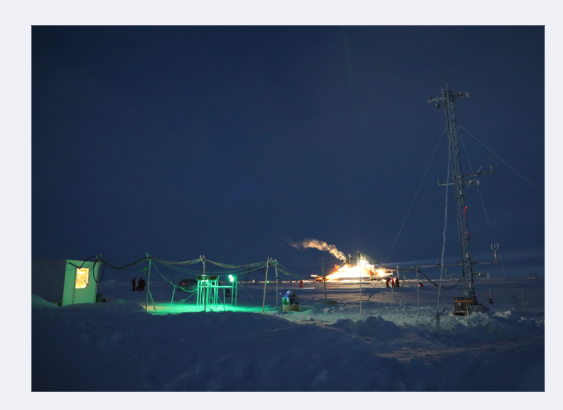
Figure 2. Meteorological data presented in this assessment were collected by instruments like this 10 meter tall tower (right) deployed on the sea ice adjacent to the Polarstern (lit up in the background). Photo Credit: Matthew Shupe

Figure 2. Meteorological data presented in this assessment were collected by instruments like this 10 meter tall tower (right) deployed on the sea ice adjacent to the Polarstern (lit up in the background). Photo Credit: Matthew Shupe

Figure 4. This figure displays atmospheric pressure (blue) and air temperature (orange) over time during the Leg 1 of the MOSAiC expedition.

MOSAiC Connection:

On November 16th, 2019 a storm rolled into the location of the Polarstern, bringing with it winds of up to 20 m/s (almost 45 mph). The storm caused new cracks to form in the ice floe, and a lead (large fractures in the ice exposing the water underneath - see Figure 5 and in the gift that is uploaded as a "Sea Ice Movement" video in the atmosphere module) opened up between the ship and three of the science sites (MET City, ROV Oasis, and the Remote Sensing Site) distributed around the ship, resulting in these sites drifting towards the port side of the ship. Some sites were relocated (Figure 6), and the science city layout had to be remapped. An important component of doing research in such a remote, rugged, and dynamic environment is being able to respond to unexpected changes in the environment and to adapt on the fly.

Figure 5. Radar image capture sea ice movement and deformation in the region around the Polarstern (red circle) from November 17, 2019. GIF Credit: DLR, TSX/TDX AO: suman_OCE3562. The Full animation of the sea ice movement for the time period of from 25/9/19 through 12/12/19 is available in the following video item, "Sea Ice Movement". You'll need to watch the gif before answering question 11 in the Atmosphere quiz!

Figure 6. After the storm, MOSAiC scientists built a bridge across a lead that opened between Ocean City and the Remote Sensing Site. Photo Credit: Stefan Hendricks

Sea Ice Movement

Watch this video about sea ice floe movement around the Polarstern. Credit: DLR, TSX/TDX AO: suman_OCE3562

Video file
Test Icon

Module 2 Assignment

Take the Atmosphere Assignment

Assignment details

  • This assignment is optional
  • Assignment should take less than 30 minutes to complete
Satellite image showing swirling cloud formations over the Pacific Ocean near the western coast of North America. The clouds vary in density, with thick white clouds concentrated near the landmass and thinner, streaky clouds over the ocean. The coastline of Baja California and part of mainland Mexico are visible on the right, contrasting with the deep blue ocean.

Read about the MOSAiC expedition's atmosphere team in the news

The Arctic atmosphere -- A gathering place for dust?

Read this article about the ways in which the atmosphere team studies dust during MOSAiC.

Photo: Marcel Nicolaus/MOSAIC

How does the atmosphere affect the temperature and/or thickness of Arctic sea ice?

The central scientific question for MOSAiC is how a changing sea ice cover will impact the climate system. After completing the atmosphere module please contribute to the discussion around the following question: 

How does the atmosphere affect the temperature and/or thickness of sea ice in the Arctic?

Participation is optional, feel free to right down your response on separate piece of paper!

MOSAiC Image

Join us in exploring the MOSAiC distributed research network

MOSAiC Distributed Network - Google Expedition

Explore the MOSAiC Distributed Network on the sea ice surrounding the Polarstern vessel. In eight scenes you can immerse yourself in the set-up of the autonomous research stations and explore the science. 

Module 3 - The Arctic Ocean

Module 3 Overview

In this module, we will take you on a tour of the Arctic Ocean. We will explore topics like ocean circulation and ocean stratification with a specific focus on processes that are happening in the Arctic. You will begin to draw connections to the coupling of the atmosphere, ocean, and sea ice and explore the chemistry of the ocean, nutrient distribution, and ocean productivity. The module concludes with an overview of the goals of the MOSAiC Ocean research group and the data they are collecting.

Learning Objectives
  • Describe wind- and buoyancy-driven circulation in the Arctic Ocean and connections between Arctic Ocean circulation and climate change
  • Explain the coupling of the ocean with the atmosphere and sea ice
  • Understand how ocean productivity is related to chemistry and nutrient distribution
  • Describe how the MOSAiC team studies the Arctic Ocean

How the Arctic Ocean Flows with Dr. Bill Shaw

In this lesson, Dr. Bill Shaw will teach you about ocean circulation driven by wind patterns and buoyancy.

How the Arctic Ocean Mixes with Tim Stanton

In this lesson, Tim Stanton discusses the role of ocean stratification in controlling the way heat interacts with sea ice in the Arctic.

Arctic Air and Ocean with Tim Stanton

In this lesson, Tim Stanton talks about the relationship between the ocean and atmosphere in the Arctic. You'll also learn how the presence or absence of ice can affect ocean currents, vertical heat transport, solar radiation, and albedo feedback.

Ocean Chemistry and Productivity with Dr. Allison Fong (Part 1 of 2)

In this lesson, Dr. Allison Fong introduces you to nutrient biogeochemistry in the Arctic Ocean. You'll learn about nutrient distribution and how it influences primary production.

Ocean Chemistry and Productivity with Dr. Allison Fong (Part 2 of 2)

In this lesson, Dr. Allison Fong discusses Arctic ice melt and what this means for the surrounding biological environment. You'll ponder the question: Will the Arctic be net primary productive or will it ultimately be a source of carbon?

Goals of the MOSAiC Team with Dr. Benjamin Rabe

In this lesson, Dr. Benjamin Rabe talk about the MOSAiC expedition as a whole and what kinds of things scientists will be studying. From observing tiny microorganisms to larger weather patterns, MOSAiC aims to better understand the Arctic system and how it affects change on a global scale.

Arctic Ocean Quiz Background Context

Background:

When selecting a suitable ice floe with which to attach the German icebreaker, Polarstern, MOSAiC scientists had to consider many factors including the size, thickness and strength of the ice floe as well as the drift path of the ice floe. Scientists use satellite images and data from microwave and laser instruments to determine the characteristics of ice floes, and rely on drifting buoys to understand how water at the ocean’s surface moves. These patterns of movement are otherwise known as ocean currents. 

Instructions:

Each of the 3 satellite images below show sea ice that contains more rounded ice floes with a low risk of breaking apart. Microwave and laser instruments also suggest that the ice in these locations is thick enough to support people and instruments on top of it. 

After selecting these 3 locations as possible starting points for the MOSAiC expedition, scientists must next consider where the ice is likely to drift by reviewing drifting buoy data (Map A). Your job is to determine which of these locations would be the ideal starting point for the Polarstern knowing that:

  1. The icebreaker must start in the central Arctic so that, frozen in sea ice, it will drifts across as much of the Arctic as possible.
  2. The icebreaker cannot drift into Russia’s exclusive economic zone (EEZ), a region 200 nautical miles from Russia’s shoreline in the Arctic where international data collection is prohibited (Map B).

Test Icon

Arctic Ocean Assignment

Click here to take the Arctic Ocean Assignment

Assignment details

  • This assignment is optional
  • Assignment should take less than 30 minutes to complete
Photo: Marcel Nicolaus/MOSAIC

Reading

Beneath the Arctic's Sea Ice, Robots are Illuminating a Mysterious World

Read about the work of the expedition's ocean team. 

Photo: Marcel Nicolaus/MOSAIC


How could declining sea ice cover impact large scale ocean circulation?

The central scientific question for MOSAiC is how a changing sea ice cover will impact the climate system. After completing the atmosphere module please contribute to the discussion around the following question: 

In which ways could a decline in Arctic sea ice and the resulting changes in salinity and temperature of Arctic Ocean waters impact large scale ocean circulation patterns?

Participation is optional, feel free to right down your response on separate piece of paper!

Module 4 - Sea Ice

Module 4 Overview

In this module, you will learn about sea ice and the important role it plays in the Arctic climate system. We will discuss how sea ice forms, how sea ice interacts with sunlight, and how sea ice moves and behaves. We will also explore the change in sea ice thickness and distribution in the Arctic over time and in response to a changing climate. The module concludes with an overview of the goals of the MOSAiC Sea Ice research group and the data they are collecting.

Learning Objectives
  • Describe sea ice formation and the role of snow on sea ice
  • Understand important optical properties of sea ice
  • Explain sea ice dynamics - how sea ice moves and behaves
  • Discuss changes in sea ice extent and thickness over time and in response to a changing climate
  • Describe how the MOSAiC team studies Arctic sea ice.
     

The Story of Sea Ice with Dr. Julienne Stroeve

In this lesson, Dr. Julienne Stroeve explains her research with MOSAiC in studying Arctic sea ice thickness. Using 40 years of satellite observations, she can track how quickly sea ice volume is declining.

How Sea Ice is Made with Dr. Melinda Webster

In this lesson, Dr. Melinda Webster explains sea ice formation. You'll learn about its role in driving ocean circulation, different shapes the ice can take on, and what affects sea ice growth vs. reduction.

Sunlight and Arctic Sea Ice with Dr. Bonnie Light

In this lesson, Dr. Bonnie Light adds new meaning to her name! You'll learn about sunlight's vital role in the Arctic system — specifically, how it affects melting in the summer and how different albedos play into this.

Sea Ice Dynamics with Dr. Jennifer Hutchings

In this lesson, Dr. Jennifer Hutchings describes Arctic sea ice dynamics and how ridges and leads form during the transpolar drift.

Sea Ice Kinetics with Dr. Jennifer Hutchings

In this lesson, Dr. Jennifer Hutchings defines sea ice kinetics. Throughout the MOSAiC expedition, scientists will be monitoring the kinematics of ice motion and determining the forces involved in opening, shearing, and closing sea ice.

Sea Ice Thermodynamics with Dr. Donald Perovich

In this lesson, Dr. Donald Perovich discusses sea ice mass balance. You'll learn about the data collection tools used by MOSAiC scientists including stakes, temperature strings, and autonomous buoys that measure Arctic ice melt and growth through the seasons.

Why Study Sea Ice? with Dr. Marcel Nicolaus

In this lesson, Dr. Marcel Nicolaus describes his role as MOSAiC's sea ice team leader and why their work is so crucial to the expedition. In studying sea ice, snow, and microorganism habitats, the team hopes to improve Arctic forecasts and better understand how drifting patterns/processes interact.

Sea Ice Quiz Background Context

Part 1: Ice Thickness Calculation
Background:

On January 8th, 2020, the Polarstern was officially farther away from civilization than the International Space Station, which orbits at an altitude of ~400 km (~250 miles) above the Earth's surface! This extreme isolation means that there must be a plan in place in case there is an emergency on the ship where someone needs to be transported quickly back to land. In the photo above (taken by Michael Gallagher aboard one of the expedition helicopters), you can see the recently constructed runway that was built for small planes to land in case of such an emergency. The runway is 400 m (>1300 ft) long and 25 m (~82 ft) wide, and was cleared by a 'PistenBully,' a machine used to groom ski slopes. This might qualify as the world's most remote airplane runway! Photo Credit: Michael Gallagher

Instructions:

Airplanes are an important part of Arctic expeditions both in terms of resupplying the expedition and emergency management. Scientists use Gold's Formula, h=√(P/A), to calculate the ice thickness (h) that is needed to support the weight of something (P). A in this equation is a constant that is related to assumptions about the nature of the ice (is it very cold and hard, is it thawing and weak, or is it somewhere in between)? We recommend using 50 pounds per square inch for A, which is a conservative value for thawing (and thus the least strong) ice.


Part 2: Ice Watch
Background:

MOSAiC scientists participated in the “Ice Watch” program when sailing through the Arctic in transit to and from the Polarstern. The program required scientists to take turns gathering hourly observations of sea ice including the concentration, type, thickness, floe size, among other sea ice characteristics. These sea ice observations were reported to ice services (e.g., National Weather Service, National Ice Center, port authorities) and are used to improve sea ice charts and forecasts. Photo Credit: Anne Gold

Instructions:

There are 8 steps involved in doing an Ice Watch; however, you will be trained to gather sea ice observations related to only steps 2 and 3. Review the descriptions and images describing steps 2 and 3 below and then apply what you’ve learned in the following quiz to gather observations of sea ice!

  1. Identify a field of view
  2. Assess the Total Concentration of ice (fractional area/10)
  3. Identify the ice type(s) in the field of view
  4. Estimate partial concentrations
  5. Assess surface features: snow, topography, melt
  6. Assess thickness of ice and snow
  7. Any color in the ice?
  8. Look at the sky
Step 2

Assess the Total Concentration of ice (fractional area/10) - The total ice concentration is the fraction of ocean covered by any type of sea ice and is estimated in tenths (to the nearest 10%).

Figure 1. An Ice Watch observer determined that 9/10 or 90% of the field of view displayed in the image above is covered by sea ice. Reference: ASPECT training CD-ROM.

Figure 2. Use this figure as a guide to help estimate the total ice concentration for any field of view (in-person observation, photo, etc.) Reference: MANICE (Canadian Ice Service, 2005).

Step 3

Identify the ice type(s) in the field of view -  This step in the Ice Watch protocol requires the observer to identify the ice type(s) visible in the field of view.

Figure 3. This figure shows photos of 11 different types of sea ice. There are often multiple types of sea ice present in the same field of view. Reference: Reproduced from ASSIST manual v4 (Hutchings, Delamere and Heil, 2016).


Ice Moving on Radar!

Daily radar images capture sea ice movement and deformation in the region around the Polarstern (credit: Jari Haapala)

Video file
Assignment Icon

Sea Ice Assignment

Click here to take the Sea Ice Assignment

Assignment details

  • This assignment is optional
  • Assignment should take less than 30 minutes to complete

Dinner conversation about the science of MOSAiC & report back in discussion thread.

What did you learn so far? What is fascinating about the science of MOSAiC? What are burning question? 

Share some of these thoughts over dinner with family or friends and report back about the conversation. 

Participation is optional, feel free to right down your response on separate piece of paper!

MOSAiC ship

Read about the MOSAiC sea ice team in the news & in first science paper

Searching For Solid Ice As Scientists 'Freeze In' To Study A Warming Arctic

Listen to NPR's Ravenna Koenig reporting on the search for the right ice floe.

The MOSAiC ice floe: sediment-laden survivor from the Siberian shelf

Read about the origin of the "Fortress", the ice floe that the Polarstern calls home for her drift across the Arctic Ocean. This is the first scientific publication from the MOSAiC team. 
 

Module 5 - Arctic Biochemistry/Ecosystem

Module 5 Overview

In this module, you will learn about the ecosystems of the Arctic Ocean. We will briefly explore the megafauna, such as polar bears, but then focus the exploration on the importance of the microfauna, such as algae and plankton, and their connections to oceanic nutrient cycles and atmospheric phenomena. The module concludes with an overview of the goals of the MOSAiC Biogeochemistry and Ecosystems research group and the data they are collecting.

Learning Objectives

  • Explain the Arctic Ecosystem and food chains in the Arctic Ocean
  • Discuss the importance of seasonality with respect to photosynthesis and the carbon cycle
  • Describe what lives in sea ice and how life adapts to the Arctic environment
  • Explain the role that aerosols play in the Arctic climate system
  • Describe how the MOSAiC team studies Arctic ecosystems and biogeochemistry in the Arctic system

Life Beneath the Ice with Dr. Carin Ashjian

In this lesson, Dr. Carin Ashjihan will introduce you to Arctic marine life by highlighting important organisms in the food chain. She'll take you through a 4-step process to answer the question: How can we protect, conserve, and manage Arctic ecosystems in the future?

Life in Sea Ice with Dr. Jeff Bowman

In this lesson, Dr. Jeff Bowman will teach you about metabolic challenges and opportunities present for organisms living in Arctic sea ice.

Adaptations to Life in Sea Ice with Dr. Jeff Bowman

In this lesson, Dr. Jeff Bowman touches on differences between the adaptive strategies of warm vs. cold-bodied organisms. You'll learn about homeostasis and thermal equilibrium as they relate to the harsh Arctic environment.

Arctic Sea Ice Ecology with Dr. Hauke Flores

In this lesson, Dr. Hauke Flores describes sea ice as an important driver in Arctic food webs. You'll learn about the serious threats climate change poses to biodiversity and key species dependent on ice cover.

What Starts Up, Must Go Down: Productivity in the Arctic Ocean with Dr. Clara Hoppe

In this lesson, Dr. Clara Hoppe sheds light on the small but mighty phytoplankton! You'll learn about MOSAiC's special interest in primary production, carbon export, and groundbreaking data scientists expect to glean from the expedition.

All About Atmospheric Aerosols with Dr. Jessie Creamean

In this lesson, Dr. Jessie Creamean discusses how aerosols affect clouds and precipitation in the atmosphere and why they're important to the Arctic.

Why Study the Arctic Ecosystem? with Dr. Brice Loose

In this lesson, Dr. Brice Loose covers the topics of microbial carbon cycling and ocean circulation. He poses the question: What happens to ecosystems and to ocean biogeochemical cycles in the new Arctic?

Arctic Ecosystem Quiz Background Context

An Adorable Menace: the Arctic Fox

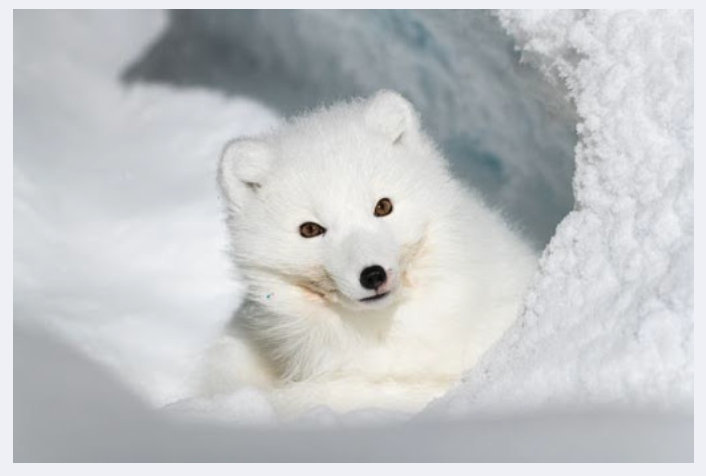
On January 6th, 2020 Team ICE discovered that two power cables of a battery set connected to a Global Navigation Satellite System station were destroyed. White hair  found on the instrument made this an easy case to solve, the offender: the Arctic fox. Team ICE scientist Polona Itkin says this isn’t the first time a curious Arctic fox has destroyed MOSAiC instruments, “This all white, beautiful animal created a lot of trouble on the ice floe in the end of December, when it nibbled on data and power cables and thus disconnected the meteorological measurements in MET City from the network and created a lot of damage there as well as at the remote sensing site. We were able to scare it away after it first seemed it would only like to play with us. We would like to have another visit of one of these beautiful animals - but would prefer having an individual with different taste!”

The photographs above and below are of the actual Arctic fox accused of wreaking havoc on MOSAiC instruments. If you look closely at the image below, you can actually see a speck of blue on the fox’s right shoulder -- this is insulation from the cables it chewed!

Take the Ecosystems Quiz to answer a question about the arctic fox's coat!

Learn more about the Arctic fox. 

Read more about how climate change could impact animals like the Arctic fox.

Assignment Icon

Arctic Ecosystem Assignment

Click here to take the Arctic Ecosystem Assignment

Assignment details

  • This assignment is optional
  • Assignment should take less than 30 minutes to complete

Follow the MOSAiC's ecosystem & biogeochemistry team in the news.

Listen to the conversation with MOSAiC scientist Jessie Creamean about her work.

Discuss how decline in sea ice will affect the Arctic food web.

Decreasing Arctic sea ice could significantly affect the Arctic food web as organisms from algae to Polar bears rely on sea ice for survival. Algae live and grow on the bottom of sea ice and make up the base of the Arctic food web, while sea ice provides a platform for Polar bears to travel deep into the central Arctic each winter in search of their favorite prey, seals.

Discuss how decline in sea ice will affect the Arctic food web.

Credit: Oceans North - KUT 

Participation is optional, feel free to right down your response on separate piece of paper!

Module 6 - Modeling Using Data from the Arctic

Module 6 Overview

In this module, you will dive into the world of climate modeling. You will learn from MOSAiC researchers what the different modeling approaches are, what we can learn from models, and how we can use field data from expeditions like MOSAiC to improve model forecasts. The module concludes with an overview of the goals of the MOSAiC Modeling research group and the data they are collecting.

Learning Objectives

  • Understand the importance of models on our understanding of weather and climate
  • Explain the difference between short term forecasting models, regional models and climate models
  • Describe how data collected during the MOSAiC expedition will benefit climate models

Why Study the Arctic? Goals of the MOSAiC Modeling Team with Dr. Gunilla Svensson

In this lesson, Dr. Gunilla Svensson explains how important Earth system models  are to understanding where both global and Arctic climate systems are headed. You'll also learn about the key role MOSAiC's modeling team plays in the expedition.

Arctic Short-Term Forecasting with Dr. Amy Solomon

In this lesson, Dr. Amy Solomon will teach you about her role in MOSAiC in coordinating international forecasting efforts. Data collected in the Arctic during the expedition form the basis of more accurate regional and global models in the future.

Arctic Regional Modeling with Dr. Wieslaw Maslowski

In this lesson, Dr. Wieslaw Maslowski explains the process of formulating regional models of the Arctic. You'll learn about the relative benefits of such models compared to those at the global scale.

Climate Modeling to Understand a Changing Arctic with Dr. Marika Holland

In this lesson, Dr. Marika Holland will teach you about climate models. She also asks the question: How will climate extremes and environmental changes in the Arctic reverberate around the world?

What is Process Modeling? with Dr. Amy Solomon

In this lesson, Dr. Amy Solomon defines process modeling as an iterative process between observations and theory. You'll learn with specific examples how scientists in both the SHEBA and MOSAiC expeditions move through this process in their work.

Modeling Quiz Background Context

Background:

The earth’s climate is a large and complex system with a lot of moving parts that affect everyone everywhere. Large and complex systems can be represented by models, which are tools we can use to better understand and visualize a system and test what might happen if we change certain parts of it. Climate models are essentially many lines of computer code that pull together and solve many of the equations that govern our physical world. In order to make climate models as realistic and effective as possible, we have to collect data on the ground, in the sky, and below the seas -- and then feed that information into the models along with the physical equations. That’s why research expeditions like MOSAiC are so important - MOSAiC scientists are gathering data from one of the most remote regions of the planet, which also happens to be one of the most important for understanding and modeling the global climate system.

Instructions:

Use the figures below to answer questions in the Modeling Quiz!

Figure 1. This figure shows the average temperature change between 1970 and 2017 around the world. Figure from NASA, GISS.

Figure 2. This figure shows model projections of warming for 2090-2100 relative to 2005-2015 for all latitudes. Temperatures are expected to increase across all latitudes; however, models disagree on the amount of warming for each region. The greater the difference between the lower and upper boundary of projected warming (dark blue), the greater the uncertainty is for future temperatures in that region. For example, warming projections suggest that the equator will be ~2-4.5°C warmer in 2090-2100 relative to the 2005-2015, a range of 2.5°C. Figure from the IPCC (RCP8.5 scenario). 

Assignment Icon

Modeling Assingment

Click here to take the Modeling Assignment

Assignment details

  • This assignment is optional
  • Assignment should take less than 30 minutes to complete

Follow the MOSAiC modeling team and colleagues from Year of Polar Predictions in the news

Learn more about the World Meteorological Organization (WMO) Year of Polar Predictions effort in this video that describes how the work will improve predictions of weather, climate and ice conditions in the Arctic and Antarctic. MOSAiC scientists work closely with Year of Polar Predictions (YOPP).

How could MOSAiC scientists decrease uncertainty in their model outputs?

The figure below compares modeled and observed measurements of average September sea ice extent over time.

How are the two datasets similar? Different? What could MOSAiC scientists do to bring the two datasets more in line with one another?

Participation is optional, feel free to right down your response on separate piece of paper!

Module 7 - Challenges in the Arctic

Module 7 Overview

In this lesson, Drs. Anne Gold and Matthew Shupe quickly overview Module 7: Challenges in the Arctic.

A Changing Climate, A Changing Arctic with Dr. John Walsh

In this lesson, Dr. John Walsh discusses how climate change is apparent throughout the Arctic (air, land, ice, and ocean) and that these changes are already impacting humans, wildlife, and the environment.

Arctic Climate System and Pan-Arctic Connections with Dr. James Overland

In this lesson, Dr. James Overland discusses how sea ice loss can cause major changes in the Arctic climate — and more specifically, in the polar jet stream.

Does a Warming Climate Mean a More Accessible Arctic? with Dr. Scott Stephenson

In this lesson, Dr. Scott Stephenson focuses on the link between climate change and human activities. You'll learn how melting sea ice contributes to economic transformation of the Arctic.

Pollution in the Arctic with Dr. Katrin Vorkamp

In this lesson, Dr. Katrin Vorkamp describes the Arctic as a recipient of global pollution. You'll learn how man-made pollutants contaminate sea ice and the food chains Arctic communities rely on and how governing bodies tackle the issue.

Arctic Ocean Acidification: Ecosystems and Economies with Dr. Jessica Cross

In this lesson, Dr. Jessica Cross discusses ocean acidification and the dangers it poses to areas like marine life and food security. She'll also teach you about steps communities can take to better understand and face the challenge of climate change.

Arctic Peoples: A Changing Climate, Changing Ways of Life with Kaare Sikuaq Erickson

In this lesson, Kaare Sikuaq Erickson discusses the Ukpeaġvik Iñupiat Corporation (UIC) and its role in nearly twenty-five thousand research sites in/around Barrow, Alaska. You'll also learn about Arctic indigenous populations that live in areas affected by climate change.

Polar Bears: Changing Climate Ecosystems with Alysa McCall, Dr. Steve Amstrup, and Trude Hohle

In this lesson, Alysa McCall and Dr. Steve Amstrup talk all things polar bear! You'll learn how climate change affects them and hear from Trude Hohle about their role in the MOSAiC expedition.

Course Wrap-Up

In this video, Drs. Anne Gold and Matthew Shupe conclude the series "Frozen in the Ice: Exploring the Arctic" with a summary of the course's major lessons.

A polar bear stands on a sheet of ice surrounded by floating ice chunks in an Arctic seascape. The water is a pale blue, reflecting the sky, and the ice varies in size and shape, creating a cold, rugged environment. The bear appears to be looking toward the horizon, emphasizing the vastness of the icy landscape

Follow the MOSAiC expedition in the news & News about a changing Arctic

Arctic Report Card
  • Learn about the state of the Arctic in 2019 and changes that are happening.
How polar bear guards protect the largest Arctic expedition ever
  • Learn more about the polar bear guards on MOSAiC

Reflection on Climate Science Collaboration, Part 2

At the beginning of the course, you responsed to the following discussion prompt:

MOSAiC is one of the most extensive Arctic expeditions ever attempted. This massive international effort is bringing together scientists from across many disciplines to better understand the changing Arctic climate system and to collect data to better inform global climate models.

Why do you think it is important to bring scientists from across many disciplines (ocean, atmosphere, sea ice, ecosystems) together to study Arctic climate processes?

After having completed all of the content in this course, please answer this question again. You will use your discussion board post as the basis for the following peer-graded assessment.

Participation is optional, feel free to right down your response on separate piece of paper!

Assignment Icon

Final Assignment: What have you learned?

Next Step: Take the final assessment

In this final assessment, you will apply what you have learned across the course to 1) describe connections between each of the four main parts of the Arctic climate system (ocean, atmosphere, sea ice, ecosystems), and 2) reflect on your learning experience.

Criteria Overview:

  • This assignment is optional
  • Further instructions are located in the assingment


Survey Icon

Post-Course Survey

Please complete the Post-Course Survey to finish the Frozen in the Ice: Exploring the Arctic Course
Illustration of two people high-fiving in a work environment

Get involved and stay up-to-date with CIRES CEEE.