Why is water at the heart of so much conflict in the American West? How have major cities and extensive agricultural systems been able to thrive despite most of the region being either a desert or semi-desert environment? How will a warming climate affect the availability and use of water in a region populated by tens of millions of people?
Course Goals
Water in the Western US has four goals. After completion of the course you will:
Understand the unique aspects of water supply and demand issues in the western US and how water systems have adapted to them;
Explain historical and scientific issues around water management in the West;
Recognize major sources of water supplies in the western US and the impact of individual “water footprints."
Describe some of the ways in which scientists study research questions related to water and climate.
Anne Gold
Anne U. Gold, PhD, is the former Director of the CIRES Center for Education, Engagement and Evaluation, and a Fellow and Senior Associate Scientist at the Cooperative Institute for Research in Environmental Sciences (CIRES) at the University of Colorado in Boulder, and an Affiliate Faculty member of CU's School of Education. She focuses on science education for educators, students, communities and the public around climate, water, environmental hazards, polar regions and geosciences in general. She is interested in understanding and studying effective ways of teaching and learning and is dedicated to grounding her education work in rigorous research and evaluation. She is passionate about building local partnerships with communities. Anne has led dozens of NSF, NOAA and NASA-funded education projects. As the founding director of CEEE, she formed a vibrant group of outreach and education professionals who develop engaging and meaningful educational opportunities for all learners. She is a climate scientist by training with a doctoral degree from the University of Regensburg in Germany.
Eric Gordon
Eric Gordon has nearly 20 years of experience in environmental science, policy, and education. From 2010 to 2015, Eric served as the Managing Director of the Western Water Assessment, a NOAA-supported program that works to connect climate science to water and other natural resource managers in the Intermountain West. He served as lead editor of the Colorado Climate Change Vulnerability Study, contributed to a climate change assessment for the Southwestern US, and published on the watershed impacts of tree mortality due to bark beetle infestation. Eric holds a Master's in Environmental Studies and a Master's in Ecology and Evolutionary Biology, both from the University of Colorado Boulder, and a Bachelor's in Communication from the University of Pennsylvania. He also served as a legislative director and aide in the United States Congress for six years, specializing in environmental and energy issues. Eric now works as a high school science teacher and teaches Introduction to Environmental Science through the University of Colorado Denver and enjoys bringing water topics into the classroom. When he's not working, you can catch him on a bike or skiing on the frozen form of water in the western US!
Course Format and Schedule
Course Format:
The class consists of short (between 6 and 15 minutes in length) lecture videos featuring the course instructors or experts in specific topics. Brief in-video questions will make the lectures more interactive. Each module ends with a quiz, while a multi-part activity and a final assessment will enable you to apply what you have learned.
Assignments and Grading Policy:
Water Footprint Assignment (20%)
Weekly Quizzes (40%)
Final Assessment (40%)
Suggested Readings:
There are no required readings for this course but we will provide links to optional reading materials each week. Completing readings or exploring additional resources is NOT part of the course requirement.
Recommended Background:
There are no prerequisites for this course, and no prior knowledge is assumed.
Course Schedule:
Note: Because this course is highly interdisciplinary, the instructors have brought in a number of guest speakers to deliver lectures on their areas of expertise. Lecturer names are listed in parentheses under the title of each lecture below.
Week 1: Course Introduction and Course Basics
Lecture 1: Why Study Water in the West? (Anne and Eric)
Lecture 2: Important Things to Know About the Course (Anne and Eric)
Lecture 3: Geography of the West (Anne and Eric)
Lecture 4: Review of the Water Cycle (Anne and Eric)
Week 2: History, Politics, and Culture of Water Development in the Western US
Lecture 1: History and Development of Water in the West (Paul Lander, University of Colorado Boulder)
Lecture 2: Native American Tribes and Water (Julie Nania, High Country Conservation Advocates)
Lecture 3: Water Storage and Delivery Infrastructure (Anne)
Lecture 5: Interstate Water Conflicts and Agreements (Sue Lowry, Wyoming State Engineer's Office)
Lecture 6: Environmental Flows and the Endangered Species Act (Mark Squillace, University of Colorado Boulder School of Law)
Module 2 Quiz
Week 3: Hydrology, Water Demand, and Climate in the Western US
Lecture 1: Climate in the Western US and Water Resources (Jeffrey Lukas, Western Water Assessment, University of Colorado Boulder)
Lecture 2: Water Quality, Aquatic Habitat, and Drinking Water (Anne)
Lecture 3: Groundwater Resources (Ben Livneh, University of Colorado Boulder)
Lecture 4: Watershed Impacts (Eric)
Lecture 5: River and Flash Flooding (Kelly Mahoney, National Oceanic and Atmospheric Administration)
Lecture 6: Impacts of Climate Change in the Interior West (Eric)
Lecture 7: Water Demand for Agriculture (Regan Waskom, Colorado Water Institute)
Lecture 8: Water Demand for Urban Areas (Joanna Endter-Wada, Utah State University)
Module 3 Quiz
Water Footprint Challenge Part I
Week 4: Case Study: The Colorado River Basin
Lecture 1: Geographic and Physical Overview of the Colorado River Basin (Anne)
Lecture 2: History and Development of Water Resources in the Colorado River Basin (Paul Lander, University of Colorado Boulder)
Lecture 3: Climate and the Colorado River Basin: Past, Present, and Future (Jeffrey Lukas, Western Water Assessment, University of Colorado Boulder)
Lecture 4: The Colorado River Basin Water Supply and Demand Study (Ken Nowak, Bureau of Reclamation)
Lecture 5: Physical Attributes of the Colorado River and Experimental Flows in the Grand Canyon (Jack Schmidt, Utah State University)
Module 4 Quiz
Water Footprint Challenge Part II
Week 5: Controversial and Complex Topics in Western Water
Lecture 1: A Growing Controversy: Hydraulic Fracturing and Water Supplies (Mark Williams, University of Colorado Boulder)
Lecture 2: Understanding Water Quality Impacts: Boulder Creek Case Study (Sheila Murphy, US Geological Survey)
Lecture 3: Science, Management, and Reality: The Story of the California Bay Delta (Eric)
Lecture 4: Doing More with Less: Water Conservation and New Supplies in Las Vegas (Eric)
Lecture 5: A Collision of Impacts: The Water-Energy Nexus (Kristen Averyt, University of Colorado Boulder)
Module 5 Quiz
Water Footprint Challenge Part III
Final Assessment
Pre-Course Survey
Please complete thePre-Course Surveybefore starting the Water in the Western US course.
Why Study Water in the West
This video introduces the Water in the Western U.S. course, focusing on how climate and geography shape scarcity and management. It previews major issues using examples like the Hoover Dam and Australia’s Murray-Darling Basin.
Important Things to Know About the Course
This video introduces basic water measurement units and key terms used in Western U.S. water management and explains how the course will work.
Geography of the West
This video explains how the Western U.S. is defined by water scarcity, using features like the Continental Divide to show how geography shapes arid regions, cities, and rivers. It also highlights shared traits such as deserts, growing urban areas like Los Angeles, and major infrastructure including the Grand Coulee Dam.
Review of the Water Cycle (with a focus on the Western US)
This video explains the water cycle in the Western U.S., covering evaporation, snowmelt, runoff, and groundwater, using an animation from NASA. It shows how mountain snowpack in places like the Sierra Nevada and Rocky Mountains drives regional water supply through basic water-balance concepts.
Reading
20 minute reading assignment
Water Footprint Challenge: Background
In our first course module, you learned about the water cycle and how hydrologists try to quantify the amount of water available in a given basin. You also heard that water is a precious resource in the western U.S., where much of the land is desert or semi-desert and water is often moved between basins. As we move forward, we want you to think about the many ways this water is used in everyday life, both directly and indirectly. Over the course of the next three modules you will be asked to complete three challenges designed to help you reflect on the indirect ways people in the western U.S. use water by estimating how much water is used for electricity production, landscaping, and food production for fictional residents of the western US.
For this first part of the assignment, read the information provided here.
Context
How much water does one person use when considering all aspects of their life? A "water footprint" extends beyond just the water that we drink and use in our houses ("domestic use"). For example, significant amounts of water are used to produce food and other consumer goods, to generate energy that lights, powers, and warms our homes, and to irrigate our grass and other landscaping. The annual water footprint of the average US resident is approximately the same volume as an Olympic-sized swimming pool.
As we examine various water footprints, keep in mind the broader context of water supply availability. Even though about 70% of Earth’s surface is covered with water, less than 1% of this water is easily accessible for human consumption (Figure 1). In addition, the available water is not evenly distributed–some regions on the Earth have far less water than others. In the US, over 9 percent of watersheds have freshwater demands than exceed supply, and most of those watersheds are in the western part of the country (Figure 2; Averyt et al.).
Figure 1. Availability of freshwater across the planet. Credit: UN Water 2014
Figure 2. Water supply stress index across watersheds in the United States. Higher values (yellows, oranges, and reds) indicate areas where withdrawals outstrip demands. Credit: Averyt et al. 2011
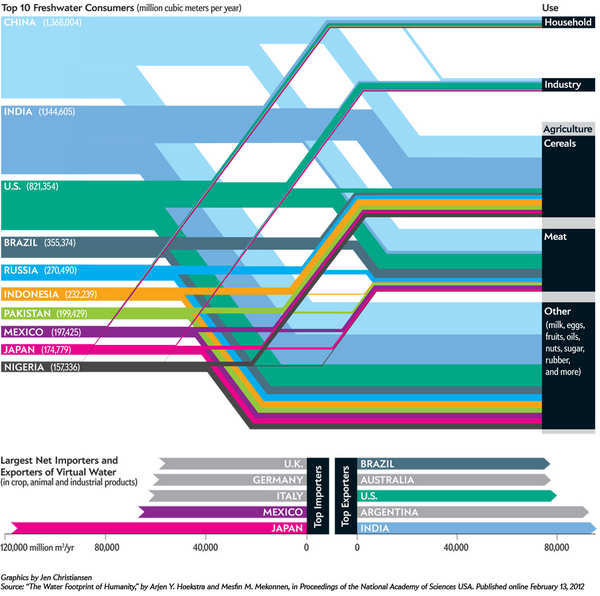
Globally, people consume over 9 billion cubic meters of water per year, but there are significant differences in consumption between countries (Figure 3; note that the graphic shows the total, not per capita use of water.)
Want to read more about where we use water in our lives? Check out these great resources:
Electricity production requires significant amounts of water. Fossil fuels, nuclear and renewable energy sources all require different amounts of water, for example to power turbines or cool machinery. Figures 4 and 5 below show the global average water use for different energy sources and the increase of energy use over the last decade.
Figure 4. Water footprint of various common energy sources, measured in cubic meters of water per terajoule (TJ) of energy produced. Note that the scale is logarithmic. Credit: Mekonnen et al. (2015) in Environmental Science: Water Research & Technology - The consumptive water footprint of electricity and heat: a global assessment
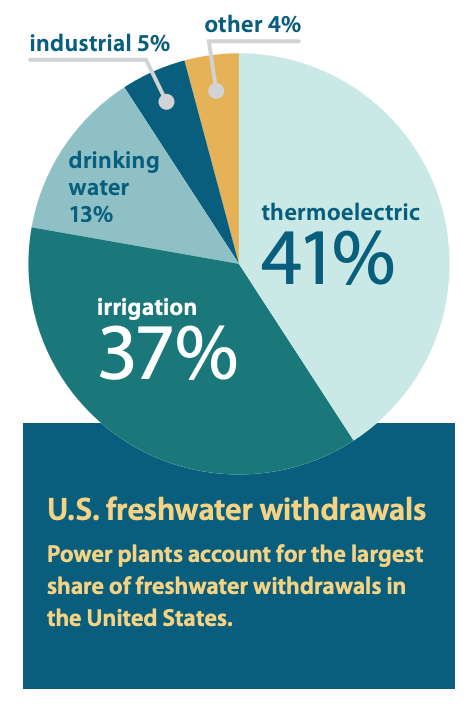
When referring to the water used in the production of electricity we have to differentiate between water withdrawals and water consumption. Withdrawals remove water from a local water source; the withdrawn water may or may not be returned to its source or made available for use elsewhere. Water consumption, on the other hand, is
the use of water in such a way that the water is not returned, usually because it is lost to evaporation. As shown in Figure 6 below, although irrigation and drinking water comprise half of all withdrawals, electricity generation is the largest single category.
Residential Outdoor Water Use
Between 50-75% of residential water consumption in the U.S. is outdoor water use (Milesi et al., 2005). Outdoor water use for lawn irrigation peaks in the summer months, the same time when water delivery systems operate at peak system capacity, and is therefore an important target for water conservation programs. Some cities in the western U.S. target water conservation for outdoor use through rewards systems that encourage the transformation of lawns into xeriscaping. “Brown is the new green” is the motto of these campaigns.
In Module 5, you'll get a look at how one surprising city in the West has aggressively tackled residential outdoor water use!
Want to learn more about residential water use? Check out these resources:
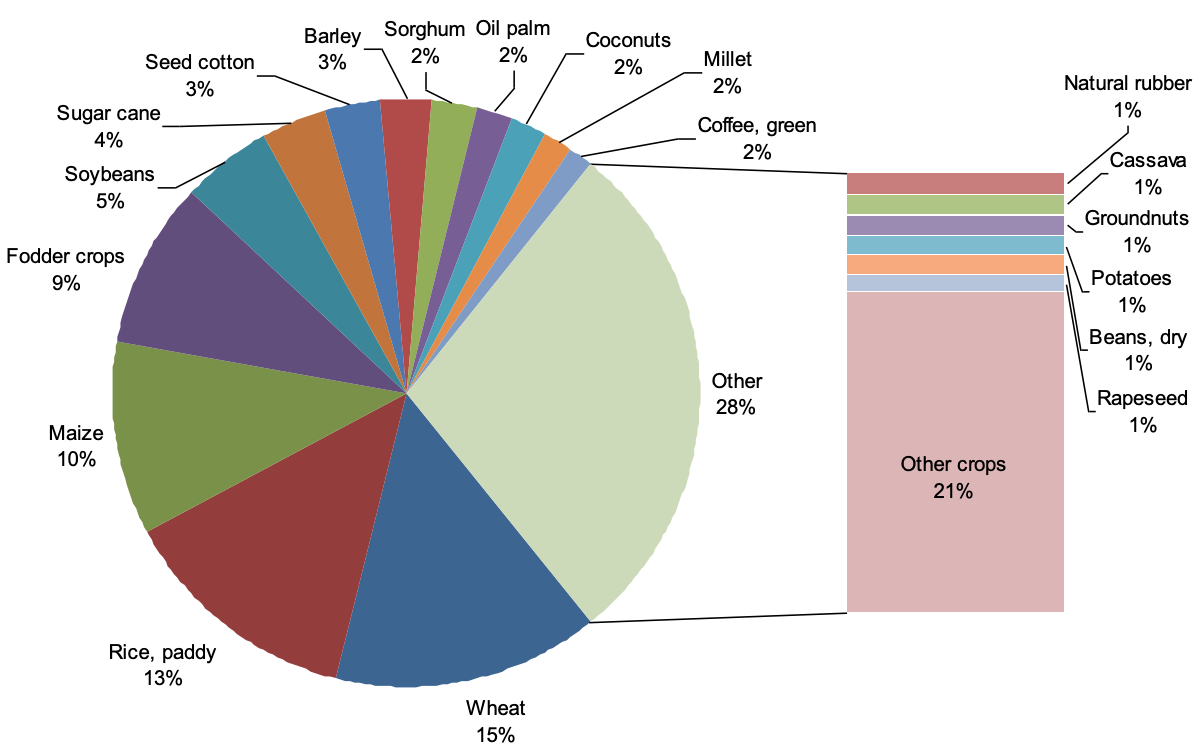
Figure 7. Proportion of the total global agricultural water footprint comprised of selected crops. Credit: Mekonnen & Hoekstra 2010
In this third water footprint challenge we take a look at the water use in food production. You will track what you eat for one day and, by using the provided resources, estimate the water used to produce that day’s meals.
Agriculture is a major user of ground and surface water in the U.S., accounting for approximately 80% of the Nation's consumptive water use and for over 90% in the western U.S. (U.S. Department of Agriculture).
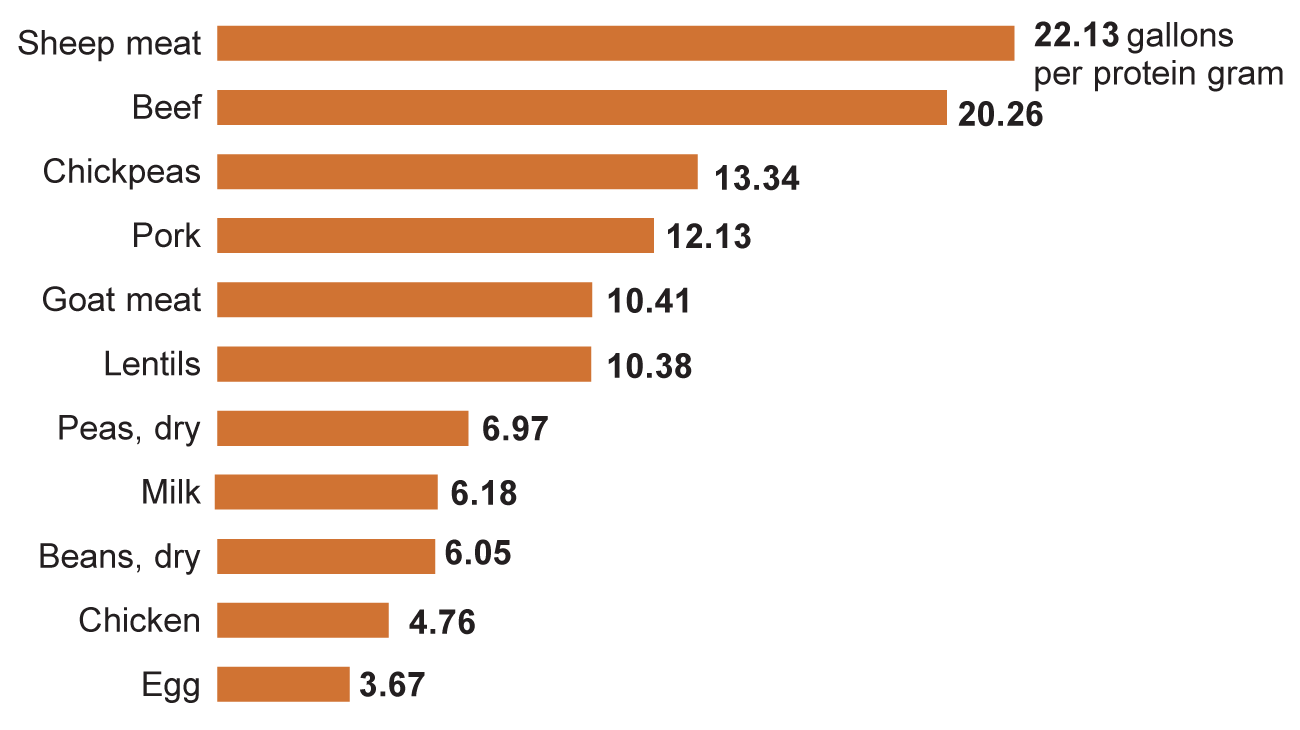
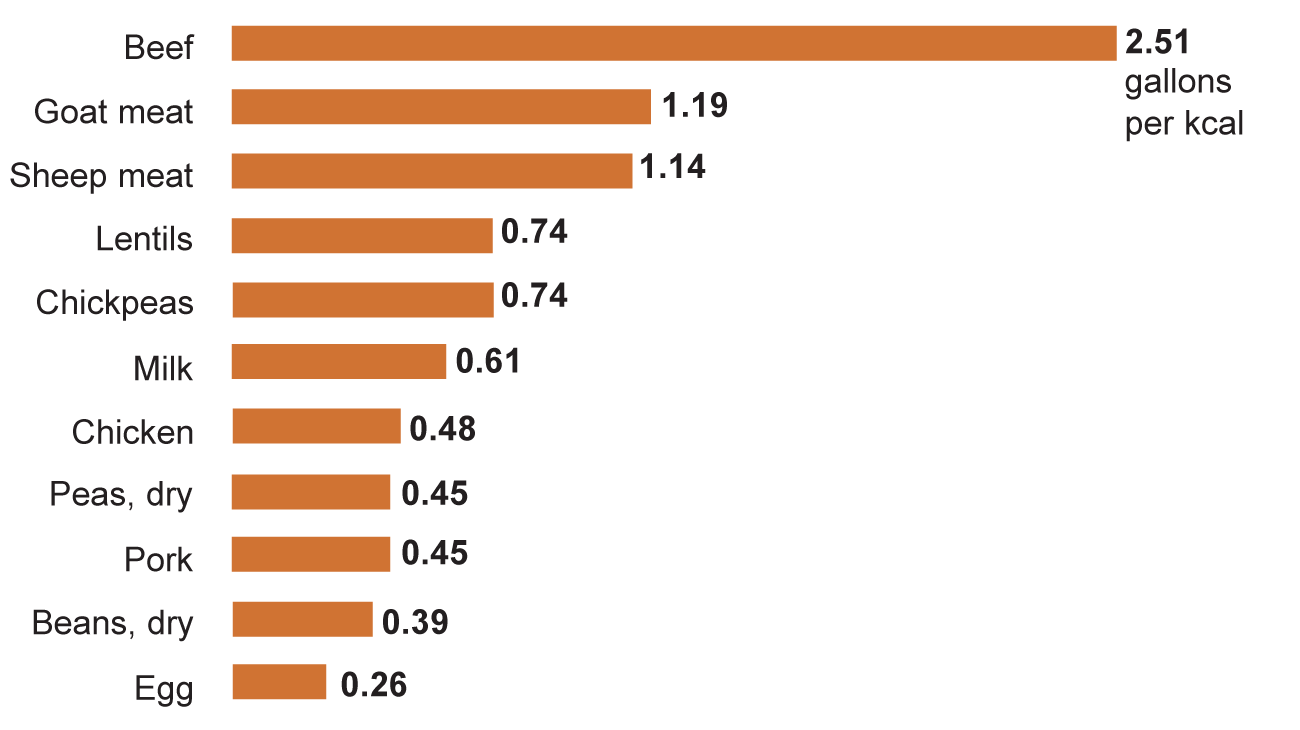
To get a sense of the relative differences in water consumption by crop type, take a look at the pie chart in Figure 7. Note that the data for that chart comes from the contribution of different crops to the total global water footprint of crop production. Production of animal-based protein has the largest water footprint. See the charts below which summarize the water footprint of food types by protein content and by calorie.
Want to learn more about the water footprint of your food? Check out these resources:
Despite being published a couple decades ago, this book still does an excellent job discussing the major features and issues facing the majority of the Western US. From defining the region, to infrastructure, the people, politics, recreation, breweries, historical legacies, and of course, water issues, you will learn a ton about what it means to live and learn about this important region. Even if you do not live in the West, it is still a great read to help you learn about the context for this course.
Prolific western author and environmentalist, Wallace Stegner, wrote this classic western water biography about John Wesley Powell and his explorations of the Western US. Most notably, Powell was the first white man to explore much of the Colorado River. After spending so many months and years exploring the river and its tributaries, he concluded that water would, indeed, be a limiting factor for economic development throughout the region. A bit wonky, but a great read nonetheless.
3. Climatic fluctuations, drought, and flow in the Colorado River Basin
This 4-page report from the United States Geological Survey will give you some good background information about weather, climate, and streamflows in the Colorado River Basin. You will learn some of this in later modules, but it might be helpful as you dive into the course. Plus, it is relatively short!
Module 2 - History, Politics, and Culture of Water Development in the Western US
How did the American West end up with many of the world's largest dams?
How does the West's unique legal system for allocating water work? Who gets the right to use water how, and why? We'll cover these topics and more in our module on history, politics, and culture!
Learning Objectives
Summarize the overall trajectory of historical water development in the Western US.
Recognize the unique water-related issues relevant to Native American tribes.
Recognize the importance of dams and water conveyance structures in the development of the modern water system in the Western US.
Describe the prior appropriation legal system as a means of allocating water supplies in the western US.
History
Learn about the world's largest dams and the history behind the U.S. water system.
History and Development of Water in the West
This video explains how water scarcity shaped settlement in the Western U.S., from early Native canal systems to modern dams and diversions. It highlights the work of John Wesley Powell, the rise of irrigation for mining and farming, and how large federal projects made urban growth possible. Cities like Los Angeles, Denver, and Phoenix expanded largely because reliable water supplies were built to support them.
Native American Tribes and Water
This video introduces the course and explains how water shapes life in the Western U.S., from deserts to snow-covered ranges like the Sierra Nevada and Rocky Mountains.
Water Storage and Delivery Infrastructure
This video uses Barker Dam above Boulder to explain how massive infrastructure was built to move and store scarce water across the West. It traces irrigation from early cultures to federal projects inspired by John Wesley Powell, highlighting landmarks like the Hoover Dam on the Colorado River and how cities such as Los Angeles grew by importing water over mountains and deserts.
Legal and Political Issues
Learn about water politics and the west's unique legal system for allocating water.
The Prior Appropriation System
This video explains Western U.S. water law using the Prior Appropriation Doctrine, contrasting it with Eastern riparian systems. It features Kate Ryan and shows how states like Colorado assign water through court decrees, emphasizing beneficial use, priority dates, and transfers that allow growing cities such as Denver to acquire senior rights originally meant for agriculture.
Interstate Water Conflicts and Agreements
States settle water disputes through compacts or the Supreme Court of the United States. Wyoming, for example, shares rivers like the Bear River with Idaho and Utah, and the Yellowstone River with Montana.
Environmental Flows: Water and the Endangered Species Act
Mark Squillace from University of Colorado Law School explains that rivers are public treasures and outlines public rights to access and protect waterways.
Scroll to end of the course to find the Water Footprint Challenge answer keys
Optional Readings and Other Resources
1. Report on the Lands of the Arid Region of the United States
In 1878, John Wesley Powell submitted his report, “Lands of the Arid Region,” to the U.S. Congress, describing the arid region of the United States and offering recommendations for its future management.
At this point, you probably have heard a lot about John Wesley Powell. If you want to read his actual reports and essays about his explorations of the Colorado River, here you go! It would be tough to read the whole thing in detail, but it is fun to skim and check out some of his original writing.
2. Colorado River Basin Ten Tribes Partnership Tribal Water Study
In the Colorado River Basin Module, you will learn about the Colorado River Basin Water Supply and Demand Study (also known simply as the "Basin Study"). Coming out of that study, it was recognized that the tribes in the Basin needed their own, detailed study about current and future water supplies and demands. Thus, the "Tribal Water Study" was released in 2018. This is a great read for those interested in learning more about modern tribal water issues.
3. The Emerging Tribal Role in the Colorado River Basin
This is one of many concise (4 pages) reports from the Colorado River Research Group (CRRG). The CRRG consists of ten prominent Colorado River scholars, scientists, and professors. In this report, they discuss how tribes have (slowly) developed a more prominent role in Colorado River discussions, but still have a long way to go. We will be providing more CRRG reports throughout the course, but feel free to check out their website for any additional readings.
4. Suggestions for further reading
Marc Reisner, Cadillac Desert (1986)Norris Hundley Jr., The Great Thirst: Californians and Water: 1770s-1990s (1992)
Norris Hundley Jr., Water and the West: The Colorado River Compact and the Politics of Water in the American West (1975)
Wallace Stegner, Beyond the Hundredth Meridian: John Wesley Powell and the Second Opening of the West (1992)
Craig Childs, House of Rain: Tracking a Vanished Civilization Across the American Southwest (2008)
Module 3 - Hydrology, Water Demand, and Climate in the Western US
Is the West drying up?
What happens to a watershed when many of the trees in it die? Let's explore the major scientific issues related to water in the American West. Along the way, we'll hear from a number of experts working on some of the latest cutting-edge research in hydrology, ecology, climate, and more!
Learning Objectives
Explain how climate and watershed impacts influence surface and groundwater resources to determine the amount of water supply available at any given time.
Recognize the influence of watershed factors on water quality and aquatic habitat.
Describe the factors involved in urban and agricultural water demand in the Western US.
Climate and Water Supply
Learn about U.S. water resources.
Climate in the Western US and Its Impact on Water Resources
Jeff Lukas of the Western Water Assessment Program at University of Colorado Boulder explains that Western water supply varies between drought and floods because of storms from the Pacific Ocean, mountain snowpack, climate cycles, and recent human-caused warming.
Water Quality, Aquatic Habitat, and Drinking Water
Water quality in the arid Western US is strongly affected by low and variable streamflow, natural factors like soil, geology, and snowmelt, and human activities such as agriculture, dams, mining, and water use, creating challenges for ecosystems, drinking water, and infrastructure.
Groundwater Resources
Groundwater is a crucial but limited freshwater resource stored in aquifers that moves slowly through soil and rock, supports about a third of the US freshwater supply, especially in arid regions, and faces risks from over-pumping, contamination, and inadequate governance.
Watershed Impacts
This video explains how wildfires, bark beetle infestations, and desert dust on snowpack change western watersheds and affect water quality and streamflow for downstream communities.
Rivers and Flash Flooding
This video explores the causes, risks, and impacts of river floods and flash floods in the western United States, including an in-depth look at the 2013 Front Range floods in Colorado.
Impacts of Climate Change on the Southwestern United States
This video explains how climate change is impacting water supply, demand, and quality in the Western United States, including effects on snowpack, drought, agriculture, hydroelectric power, and recreation.
Water Demand
Exploring water demand in urban and agricultural areas.
Water Demand for Agriculture
This video provides an overview of agricultural water use in the Western United States, covering irrigation trends, crop water requirements, efficiency strategies, conservation methods, and the challenges of producing food with limited and uncertain water supplies.
Water Demand for Urban Areas
This video explains urban water demand in the Western U.S., covering how cities use water, factors that shape consumption, and strategies to manage it. It highlights sectoral and indoor/outdoor use, supply- versus demand-side approaches, the role of human behavior and policy, tools for efficiency, and the challenges of balancing conservation with equity and sustainability.
This report was the first of its kind to take a deep dive into how much water is actually used for irrigated agriculture in the Colorado River Basin. Going state by state, the authors pull data together from a variety of sources to examine irrigated agriculture, including the types of crops grown, throughout the entire Basin.
5. Municipal Deliveries of Colorado River Basin Water
Similar to the previous report on irrigated agriculture in the Basin, this report is also one of the first of its kind to really examine how much Colorado River water is delivered to municipalities. If you live in the Basin (or Colorado River water is exported to your region) it is fun to check out exactly how much Colorado River water your city gets!
6. The twenty-first century Colorado River hot drought and implications for the future
This is one of the more recent and prominent climate change studies examining flows for the Colorado River. The author's find that temperature increases in the Basin have a prominent role in reduced streamflows, and projected increases in temperature suggest additional declines in annual streamflow as much as 20-30% by mid-century. As far as climate studies go, this one is fairly readable to non-climate scientists, and includes a "plain language summary" at the beginning!
7. When is Drought Not a Drought? Drought, Aridification, and the “New Normal”
In another short paper from the Colorado River Research Group, the authors discuss that water managers should not consider the recent dry years as a temporary drought, but rather part of a long-term shift towards a more arid region (with subsequent impacts on Colorado River streamflows). The authors suggest we should think of this as the "aridification" of the American Southwest--in other words, "the new normal". "Aridification" is a word you might begin to hear more and more...
8. Climate Change and the Colorado River: What We Already Know
In addition to the previous two readings, this CRRG paper does a good job summarizing the latest climate change science as it relates to the Colorado River Basin. This is a great read for those who want the highlights about what has occurred, and what we can expect, as temperatures continue to increase throughout the Basin.
9. New House, New Paradigm: A Model for How to Plan, Build, and Live Water-Smart
As we have learned throughout this course, the Western US has some of the fastest growing regions in the country. This report from provides tangible steps communities can take to ensure this growth occurs as water-efficiently as possible. Some communities in the West--utilizing some of the techniques in this report--have been able to grow without increasing the need for additional water supplies. Very cool!
Groundwater is a topic that seems to draw less attention than surface water but is often just as important. This is especially true in California, where groundwater is used to irrigate a large portion of the state's agricultural lands, which is very significant to country's food supply. The Water in the West program at Stanford provides a wealth of information about California's groundwater supplies and management. On this website, you'll find a variety of reports, infographics, and other resources all about California groundwater.
Module 4 - Case Study: The Colorado River Basin
Water in the Western US Case Study
The Colorado River is a vital source of drinking water for nearly 40 million people and supplies countless farms across a parched landscape. Cutting through nearly 1,500 miles of mountains and deserts, the Colorado's small size belies the fact that it is one of the most intensively managed and litigated rivers in the world. That makes this river perfect for exploring many of the concepts we've covered already in our course.
Learning Objectives
Apply the concepts learned in the previous modules to the specific challenges of the Colorado River Basin.
Geographic and Physical Overview of the Colorado River Basin
This module provides an overview of the Colorado River Basin, covering its geography, physical features, water supply to cities and farms, extensive dam and reservoir management, and its role in hydroelectric power, while setting up later discussions on history, climate, and water management challenges.
History of Development of the Colorado River Basin: The Era of Big Dams
This segment covers the history of major Colorado River infrastructure, focusing on the Hoover and Glen Canyon Dams, which were built to store water, provide reliability, and allocate flows under the 1922 Colorado River Compact, while highlighting the ongoing tension between water supply, urban growth, and environmental considerations.
Climate and the Colorado River Basin: Past, Present, and Future
This lecture explains how climate drives the Colorado River’s water variability, showing that while recent low flows are partly due to natural precipitation cycles, rising temperatures from human-caused climate change are reducing runoff and shifting snowmelt earlier, creating challenges for water management and planning for future droughts.
The Colorado River Basin Water Supply and Demand Study
Explore the Colorado River Basin Water Supply and Demand Study with Bureau of Reclamation engineer Ken Nowak, as he explains future water challenges, scenario planning, and strategies to ensure a resilient and sustainable water supply for the basin.
Physical Attributes of the Colorado River and Grand Canyon Experimental Flows
Dive into the physical and ecological dynamics of the Colorado River, exploring its historic flow, sediment transport, and how dams have transformed the river’s landscape, ecosystems, and restoration challenges from the Grand Canyon to the delta.
Read the first-person account from the famous one-armed Civil War veteran as he journeys down the Colorado River and gets to know its astounding geography.
3. Water is For Fighting Over and Other Myths about Water in the West
For those who want a good understanding about how Colorado River policies are negotiated, adopted, and implemented, this is an excellent read. Despite these decision-making processes being relatively complex, the author does a great job summarizing them in an approachable and readable manner. Definitely a go-to for those who want to get up to speed on all things Colorado River!
4. Downriver: Into the Future of Water in the West
Similar to the previous book (Water is For Fighting Over) this is a great read for anyone who wants to dive a bit deeper into Colorado River issues, although still in an incredibly readable format. The author discovers and describes many of these issues by taking a rafting trip from the headwaters of the Green River (one of the main Colorado River tributaries) in Wyoming down to the confluence with the mainstem Colorado River in Utah. In addition to water wonkiness, you get to read about a pretty epic river journey!
Throughout this module you have been learning about the "Law of the River" which dictates how the Colorado River is managed and allocated. The most recent update is the culmination of a multi-year negotiation among the seven Basin states and the federal government. Known as the Drought Contingency Plans (DCPs), this new set of guidelines determines shortages to each Lower Basin state based on elevation levels in Lake Mead. If Lake Mead elevations continue to drop, Arizona, Nevada, and California will take additional shortages to keep Mead from crashing. For additional reading, you can check out what the Upper Basin states are doing in a similar vein, as well as Mexico. If you have been following water in the news lately, you most likely have heard of these DCPs.
Feel free to reach out to the course instructors if you have any additional questions on this topic!
6. West wrestles with Colorado River “grand bargain” as changing climate depletes water governed by 1922 compact
Module 5 - Controversial Issues and the Future of Water in the Western US
Scarcity of Water in the American West
In this course, we've emphasized the importance of how the scarcity of water in the American West has shaped so many of the issues around it. In this final module, we'll present some specific cases of complex and often controversial issues that come up because of the unique nature of water in the Western US.
Learning Objectives
Apply the concepts learned earlier in the course to specific cases in preparation for further investigation of addition topics
A Growing Controversy: Hydraulic Fracturing and Water Supplies
Explore the science and controversies of hydraulic fracturing, as Mark Williams breaks down how fracking works, its impact on water quantity and quality, and the challenges of managing produced water safely.
Understanding Water Quality Impacts: Boulder Creek Case Study
Sheila Murphy explains how wildfires impact water quality and quantity, showing how burned forests increase runoff, sediment, and nutrients in watersheds, and highlighting strategies for protecting water supplies after fires.
Science, Management, and Reality: The Story of the California Bay Delta
This video explains the complexity of managing California’s Sacramento-San Joaquin Delta, highlighting the challenges of water supply, aging levees, endangered species, and environmental risks, while showing how science informs policy but cannot make the decisions in this highly contentious system.
Doing More With Less: Water Conservation and New Supplies in Las Vegas
This video explores how Las Vegas grew in the desert by relying on Colorado River water and groundwater, and highlights the city’s innovative conservation efforts, ongoing water challenges, and controversial plans to secure future supplies.
The Water Energy Nexus
This video explains the energy-water nexus, showing how electricity generation requires large amounts of water and how water systems consume significant energy, highlighting the tradeoffs, challenges, and future implications for sustainable resource management in the western United States.
This final lecture wraps up the course on water in the western United States, reviewing key topics, future challenges, and encouraging further exploration and discussion on the region’s complex water issues.
Optional Readings and Other Resources
1. EPA's Study of Hydraulic Fracturing and Its Potential Impact on Drinking Water Resources
This is the paper summarizing the research that Sheila Murphy describes in her video lecture about water quality impacts in the Boulder Creek Watershed case study.
3. Sacramento-San Joaquin Delta Historical Ecology Investigation: Exploring Pattern and Process
This report by Kristen Averyt (from our lecture on the energy-water nexus) and others provides an overview of how much water is consumed for energy production in the US.
In this final assessment, you will apply what you have learned across the course to a summary of an current or ongoing controversy related to water in the western US.
Grading Criteria Overview:
This assignment is optional
Further instructions and rubric can be found below
Step-By-Step Assignment Instructions:
Congratulations! You just got a job as an aide to a newly elected United States Senator from a western state who needs to get up to speed quickly on a variety of issues. You are tasked with summarizing some important controversies in western water policy. Please write a short memo on one of the topics below. The senator needs a summary of the critical aspects, but their time is very valuable, so your memo should be at least one but no more than two pages long.
You’ll need to:
Craft a memo appropriate to the context (i.e., it should be very professional);
Write a clear introductory paragraph outlining what the memo contains;
Provide an overview of the scientific and legal, historical, and/or political aspects of the issue;
Describe opposing viewpoints regarding the controversy;
Explicitly reference at least one video lecture from this course to help inform the memo.
Be sure that your memo is between one and two pages long (single spaced!)
Be sure to read through the scoring rubric before writing the memo in order to know how you will be graded. This assignment is scored via peer grading. Please select from one of these important Western water topics below:
Construction of “twin tunnels” under the California Bay Delta (also known as “California Water Fix and Eco Restore” or “Bay Delta Conservation Plan”)
Water supply and quality impacts of hydraulic fracturing (a.k.a. “fracking”)
Restoration of the greenback cutthroat trout
Implementation of further experimental high release flows from Lake Powell through the Grand Canyon
Post-Course Survey
Please complete the Post-Course Survey to finish the Water in the Western US Course